If you feel like you’re always a split second behind, you’re not imagining it. This guide tackles the #1 factor limiting your in-game potential: response time. The real issue isn’t just your hardware—it’s the tiny but critical delay between your brain making a decision and your hands executing it. Inside, you’ll find pro-level physical and digital exercises built to shrink that gap. These aren’t generic tips. They’re targeted reaction time drills designed to sharpen fine motor control for both stick-based controllers and mouse-and-keyboard play—giving you a measurable competitive edge.
The Neuromuscular Link: Why Physical Drills Translate to Digital Speed
Incorporating warm-up drills into your pre-match routine can significantly enhance your reaction time, much like the way mastering new strategies in games featured on ‘New Video Games Thehakegamer‘ can sharpen your reflexes in a virtual arena.
The real edge in competitive gaming isn’t “fast fingers.” It’s the brain-to-thumb connection—the neural pathway that sends signals from your motor cortex to your hands. With repetition, your body builds myelin (a fatty sheath insulating nerve fibers), allowing signals to travel faster and more reliably (Fields, 2008). That’s why targeted reaction time drills outperform endless casual matches.
Critics argue speed is genetic. But studies on neuroplasticity show consistent, deliberate practice physically reshapes neural circuits (Draganski et al., 2004). In other words, “natural talent” is often trained efficiency in disguise.
What competitors miss is neuromuscular efficiency: minimizing wasted motion. On stick-based controllers, that means:
- Cleaner micro-adjustments for tracking
- Reduced overcorrection on flicks
- Smoother acceleration control on analog input
These gains compound when paired with building consistency habits of highly skilled gamers.
Raw speed matters. But precision under pressure? That’s engineered.
Foundational Hand & Wrist Agility Exercises
Finger Dexterity Taps
If your thumbs feel slow on an analog stick, the problem usually isn’t “bad aim” — it’s poor finger isolation. Finger dexterity taps (sometimes called “finger pianos”) train each finger to move independently. Lay your hand flat and tap one finger at a time in sequence. Then try thumb-to-finger touches, increasing speed without losing accuracy.
I’m convinced this is the most underrated drill in controller mechanics. Players obsess over sensitivity settings but ignore the hardware attached to their wrists. Precision starts in the fingers. Think of it like learning combos in a fighting game — slow first, clean second, fast last.
Wrist Mobility and Flexibility
Flexor stretches (palm out, fingers gently pulled back) and extensor stretches (palm down, pressing fingers inward) improve range of motion and may help reduce repetitive strain injuries (RSI), a condition caused by repeated stress on muscles and tendons (Mayo Clinic). Add controlled wrist circles for joint lubrication.
Some gamers skip this because it feels “too basic.” I disagree. Mobility is your buffer against fatigue. Ten minutes here can save weeks of discomfort.
Grip and Endurance Training
Stress balls or grip trainers build stamina in the forearm flexors — the muscles responsible for sustained control. Over time, this reduces fatigue-related errors during long sessions. Pair this with reaction time drills for measurable improvement.
Advanced Fine-Motor Control
The “Pen Spin” or “Stick Twirl” develops micro-muscles responsible for subtle directional adjustments. It looks trivial (and slightly fidgety), but those tiny corrections are what separate average tracking from laser focus. Pro tip: practice while watching a stream — consistency beats intensity.
Digital Drills: Using Software to Hone Your Reaction Time
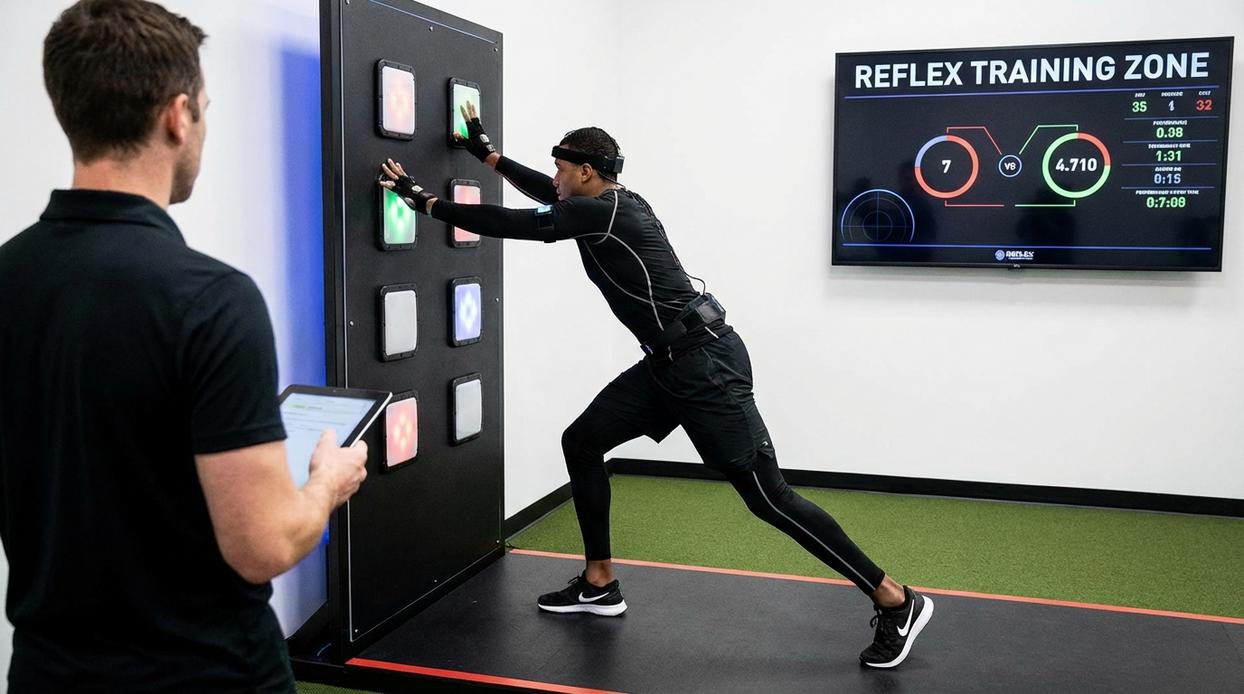
Improving reaction speed isn’t just about playing more matches; it’s about playing smarter. That’s where aim-training software comes in. Tools like Aim Lab and KovaaK’s break mechanical skills into measurable components—flicking (rapid cursor movement to a target), tracking (following a moving target smoothly), and click timing (shooting at the precise moment your crosshair aligns).
For example, Gridshot emphasizes quick flicks across a wide field, reinforcing speed and accuracy under time pressure. Meanwhile, Spider Shot isolates precision micro-adjustments, helping you correct over-aim (that frustrating moment when you overshoot a target). These drills translate directly into faster eliminations and tighter duels in competitive shooters.
Equally important, reaction time benchmarking adds hard data to your progress. Browser-based tools like Human Benchmark measure visual reaction speed in milliseconds. By testing weekly, you can track tangible gains instead of relying on “I feel faster” assumptions. Pro tip: test at the same time of day to reduce variability caused by fatigue.
Beyond standalone tools, in-game training scenarios bridge the gap to real competition. Set up custom lobbies to rehearse quick peeking (briefly exposing your character to gather intel or fire) or structured target switching against bots. Controlled reps reduce panic during high-pressure rounds.
To maximize improvement:
- Rotate between flicking, tracking, and click timing drills
- Track scores and reaction times consistently
- Simulate match conditions with limited retries
Some players argue raw gameplay is enough. However, structured software compresses practice into focused reaction time drills in the section once exactly as it is given, accelerating skill gains far beyond casual repetition.
Optimizing Your Setup for Millisecond Gains
I used to blame losses on “lag” — until I upgraded from a 60Hz monitor to 144Hz. The difference was immediate. Refresh rate (Hz) means how many times your screen updates per second. Higher Hz = smoother motion and faster visual feedback (yes, you really can see the difference). Likewise, a mouse or controller’s polling rate measures how often it reports inputs to your system. Higher polling reduces delay between action and on-screen response.
Tuning for Instant Response
Next, sensitivity. Too high and you overshoot. Too low and you drag behind. Start mid-range, adjust gradually, and test with reaction time drills. On controller, reduce deadzone — the small area where stick movement isn’t registered — until drift appears, then raise it slightly (pro tip: tiny tweaks beat massive jumps).
Finally, ergonomics matter. Sit upright, feet flat, elbows relaxed. Proper posture prevents fatigue so trained muscle memory stays sharp. Your setup should feel invisible — like a well-tuned instrument, not a wrestling match.
You wanted a practical way to sharpen your edge before every match—and now you have one. Superior performance isn’t reserved for naturally gifted players; it’s built through intentional practice and smart reaction time drills that target the exact frustration of losing by a split second.
A simple 5-minute pre-game routine—finger taps, wrist rotations, and focused aim training—directly attacks slow starts and missed opportunities. Stay consistent, and you’ll build the muscle memory that transforms hesitation into confidence.
Turn Close Matches Into Clear Wins
If you’re tired of falling behind in the first round, start your 5-minute routine today. Thousands of competitive players rely on structured reaction time drills to gain the edge—now it’s your move. Load up your drill, commit to the routine, and feel the difference in your very next game.
 There is a specific skill involved in explaining something clearly — one that is completely separate from actually knowing the subject. Sylvara Ollvain has both. They has spent years working with stick-based game controller mechanics in a hands-on capacity, and an equal amount of time figuring out how to translate that experience into writing that people with different backgrounds can actually absorb and use.
Sylvara tends to approach complex subjects — Stick-Based Game Controller Mechanics, Pro Tips Collection, Console Gaming Trends and Insights being good examples — by starting with what the reader already knows, then building outward from there rather than dropping them in the deep end. It sounds like a small thing. In practice it makes a significant difference in whether someone finishes the article or abandons it halfway through. They is also good at knowing when to stop — a surprisingly underrated skill. Some writers bury useful information under so many caveats and qualifications that the point disappears. Sylvara knows where the point is and gets there without too many detours.
The practical effect of all this is that people who read Sylvara's work tend to come away actually capable of doing something with it. Not just vaguely informed — actually capable. For a writer working in stick-based game controller mechanics, that is probably the best possible outcome, and it's the standard Sylvara holds they's own work to.
There is a specific skill involved in explaining something clearly — one that is completely separate from actually knowing the subject. Sylvara Ollvain has both. They has spent years working with stick-based game controller mechanics in a hands-on capacity, and an equal amount of time figuring out how to translate that experience into writing that people with different backgrounds can actually absorb and use.
Sylvara tends to approach complex subjects — Stick-Based Game Controller Mechanics, Pro Tips Collection, Console Gaming Trends and Insights being good examples — by starting with what the reader already knows, then building outward from there rather than dropping them in the deep end. It sounds like a small thing. In practice it makes a significant difference in whether someone finishes the article or abandons it halfway through. They is also good at knowing when to stop — a surprisingly underrated skill. Some writers bury useful information under so many caveats and qualifications that the point disappears. Sylvara knows where the point is and gets there without too many detours.
The practical effect of all this is that people who read Sylvara's work tend to come away actually capable of doing something with it. Not just vaguely informed — actually capable. For a writer working in stick-based game controller mechanics, that is probably the best possible outcome, and it's the standard Sylvara holds they's own work to.